Understanding Google's Search Algorithms: MUM, Fred, Possum, Core Updates, and Florida
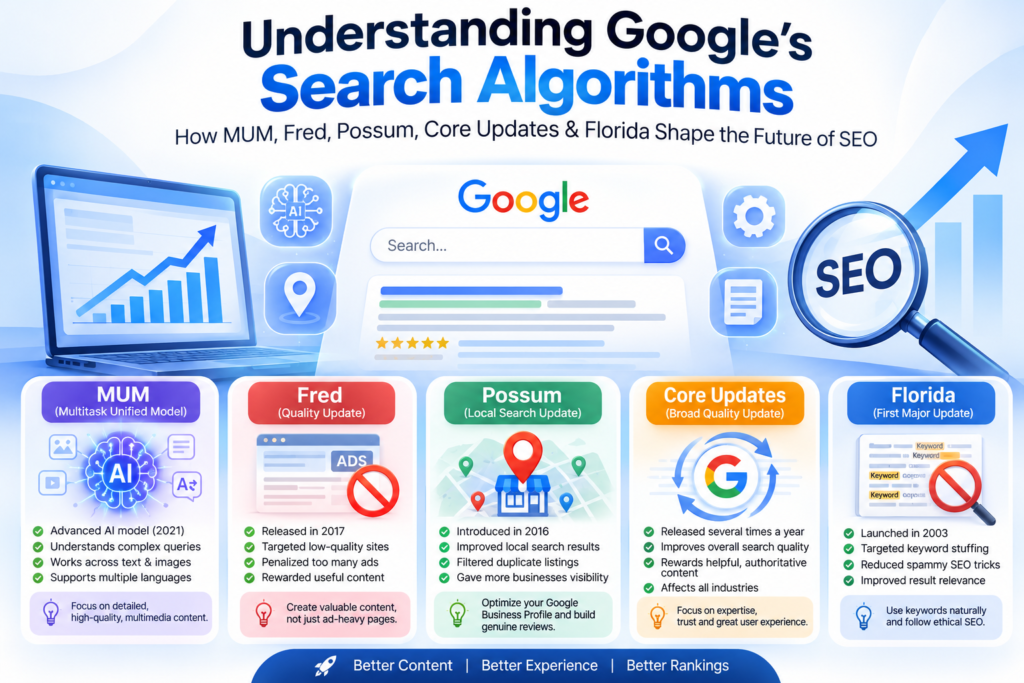
Understanding Google’s Search Algorithms: MUM, Fred, Possum, Core Updates, and Florida
- Introduction
Google processes billions of searches every day, and its search algorithms determine which websites appear at the top of the search results. Over the years, Google has introduced several major algorithm updates to improve search quality, reward valuable content, and provide users with the most relevant information.
In this blog, we’ll explore five important Google algorithm updates—MUM, Fred, Possum, Core Updates, and Florida—and understand how they have shaped modern SEO.
1. MUM (Multitask Unified Model)
What is MUM?
Introduced in 2021, MUM (Multitask Unified Model) is one of Google’s most advanced artificial intelligence models. It was designed to understand complex search queries more like a human and provide more comprehensive answers.
Unlike previous algorithms, MUM can understand information across multiple languages and different content formats such as text and images.
Key Features
- Understands complex search intent.
- Supports multiple languages.
- Analyzes both text and images.
- Provides deeper and more relevant search results.
SEO Impact
- Focus on creating detailed, high-quality content.
- Cover topics cather than targeting single keywords.
- Use images, videos, and structured content to improve user experience.
2. Fred Algorithm
What is Fred?
Released in 2017, the Fred update targeted websites that prioritized advertising revenue over user experience.
Sites filled with excessive ads, thin articles, and low-quality content experienced significant ranking drops.
Key Features
- Targets low-quality content.
- Penalizes websites with excessive advertisements.
- Rewards useful, informative, and user-focused content.
SEO Impact
- Publish original and valuable articles.
- Reduce intrusive advertisements.
- Improve readability and user experience.
3. Possum Algorithm
What is Possum?
Google introduced the Possum update in 2016 to improve local search results.
It made local SEO more accurate by considering the user’s location and filtering duplicate business listings.
Key Features
- Improves local search rankings.
- Gives more businesses an opportunity to appear in local results.
- Filters duplicate or spammy business listings.
SEO Impact
- Optimize your Google Business Profile.
- Maintain accurate Name, Address, and Phone Number (NAP) information.
- Encourage genuine customer reviews.
4. Google Core Updates
What are Core Updates?
Google releases Core Updates several times each year to improve the overall quality of search results.
Unlike targeted updates, Core Updates evaluate websites based on overall content quality, expertise, authority, and user experience.
Key Features
- Improve search relevance.
- Reward high-quality and trustworthy content.
- Affect rankings across all industries.
SEO Impact
- Publish helpful, accurate, and updated content.
- Demonstrate expertise and authority.
- Improve website speed, usability, and mobile experience.
- Keep content fresh by updating older articles.
5. Florida Algorithm
What is Florida?
The Florida Update, launched in 2003, was Google’s first major algorithm update.
It was designed to reduce search engine manipulation by targeting keyword stuffing, hidden text, and other spam techniques.
Many websites relying on outdated SEO tactics lost significant rankings after this update.
Key Features
- Penalized keyword stuffing.
- Reduced spammy optimization techniques.
- Improved the relevance of search results.
SEO Impact
- Use keywords naturally.
- Focus on content quality instead of keyword repetition.
- Follow ethical SEO (White Hat SEO) practices.
Comparison of the Algorithms
Algorithm | Released | Main Purpose | SEO Focus |
Florida | 2003 | Reduce keyword spam | Natural keyword usage |
Possum | 2016 | Improve local search | Local SEO optimization |
Fred | 2017 | Target low-quality websites | Valuable, user-focused content |
MUM | 2021 | Understand complex search intent | Comprehensive, multimedia content |
Core Updates | Ongoing | Improve overall search quality | Helpful, authoritative websites |
Best SEO Practices After These Updates
- Create original, high-quality content.
- Write for users instead of search engines.
- Keep your content updated.
- Optimize for mobile devices.
- Improve website loading speed.
- Build trust through accurate and authoritative information.
- Follow ethical (White Hat) SEO techniques.
- Optimize local business information if targeting local customers.
Conclusion
Google’s search algorithms continue to evolve with one goal: delivering the best possible experience for users. Updates like Florida discouraged spammy SEO tactics, Possum enhanced local search, Fred rewarded quality over advertisements, MUM introduced advanced AI-powered understanding, and Core Updates continue to refine search rankings based on relevance and trustworthiness.
For website owners, bloggers, and digital marketers, long-term SEO success comes from creating valuable content, maintaining a positive user experience, and staying updated with Google’s latest algorithm changes. Instead of chasing shortcuts, focus on building content that genuinely helps your audience—because that’s exactly what Google’s algorithms are designed to reward.